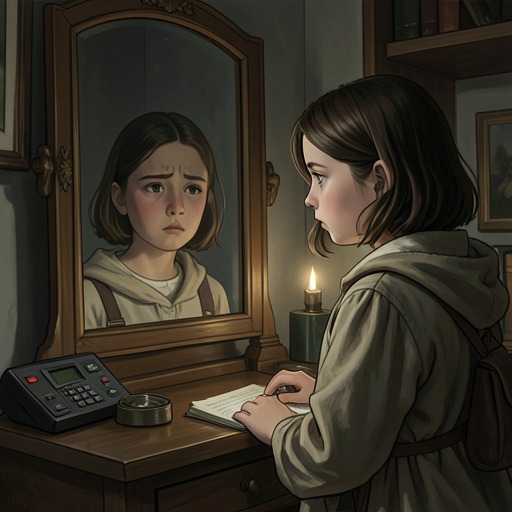
Giovanna’s adolescent crisis and self-alienation
The Lying Life of AdultsGiovanna’s adolescent crisis and self-alienation take shape as the adults around her become embroiled in conflict and her family begins to break apart. Unable to acknowledge what she suspects about the relationships between her parents and their friends, she turns to self-deception, prayer, withdrawal, and ultimately school refusal. The crisis is not simply a change in mood: it alters her habits, appearance, friendships, and sense of herself, while leaving her caught between the truth she partly understands and the family life she longs to restore.
Family Upheaval and the Unspoken
In the aftermath of the fight between her father and Mariano, Giovanna recognizes that the adults’ quarrel is not really about Marxism, despite the political language around it. She and her friends sense that the conflict has opened an unwelcome view of their parents’ sexuality, something they experience as distant from their own youthful interests and deeply unsettling. Ida gives the quarrel a particularly repellent character in her description of the men’s words; Giovanna, who knows more than Angela and Ida about the families’ secrets, finds it harder to retreat into their shared explanations. She withdraws from the telephone confidences, fearing that one careless word could open a passage to the facts.
Giovanna’s guesses gather around a chain of gestures and objects rather than a clear account. She suspects that Vittoria told her father what Giovanna had confided, prompting him to confront Mariano; she further imagines that Costanza discovered her husband’s intimacy with Nella and left the apartment after the fight. These remain her anxious reconstructions, not established explanations. Costanza’s subsequent visit, Nella’s altered expression, Costanza’s remorseful manner, and the white-gold bracelet that Angela and Ida’s mother helps fasten on Giovanna’s wrist become clues she cannot put into a coherent story. She wears the bracelet day and night, while privately acknowledging that she understands more about its unexplained restitution than she can admit to herself.
Lies, Prayer, and Nighttime Distress
Rather than disclose her unhappiness, Giovanna performs cheerfulness at home. She tells Nella she looks well even when she sees her mother’s face marked by depression. She continues to bring her father school exercises, although his attention has turned elsewhere and he has little wish to help. The lies are directed chiefly at herself: they let her act as if ordinary family routines still hold, even as she watches those routines lose their substance.
Prayer provides a second form of consolation. Though she says she does not believe in God, she begs that the quarrel be political rather than the consequence of Vittoria repeating Giovanna’s confidences to her father. When the available signs seem inconsistent with that hope, she imagines a more complicated explanation involving Nella and Mariano, but cannot settle on it. At night she asks God to put things back in order and fears that the family’s collapse will spread outward, as if the city itself could fall into the sea. The scale of that imagined catastrophe registers how completely she experiences the household crisis as a threat to her whole world.
Her distress also becomes physical and solitary. She wakes at night overwhelmed by anguish and gets up to vomit. She makes noise in the hope that her parents will come to her, but hears only their continued murmuring behind the light visible outside their bedroom. In the morning the family eats in silence. Giovanna’s desperate wish that something happen—even her own death, followed by resurrection into a happy family—shows how she imagines crisis as the only possible force that might interrupt their estrangement.
Withdrawal and the Rejection of School
When her father first disappears from home after repeatedly saying that Giovanna resembles his sister, she interprets his departure as a response to the revulsion she believes she inspires. Grief and resentment turn into an explicit refusal of school: she stops doing homework, does not open her books, and gradually feels alien to herself. She sheds habits associated with her father, including reading the newspaper and watching television news. Her clothing changes from white or pink to black, and her eyes, lips, and clothes become part of the same dark presentation. At school she is unmoved by teachers’ reproaches; at home she is indifferent to Nella’s complaints.
Reading novels, watching films on television, and listening to music replace study, while her speech dwindles to a few words. Her isolation deepens when Angela and Ida, already drawn into the tragedy of their families, disappear from her daily life. Giovanna describes herself as having no friends beyond their longstanding bond, and imagines her own voice circling uselessly inside her head. She laughs alone and makes faces, signs of a life increasingly turned inward rather than shared with others.
Places associated with earlier happiness become settings for this retreat. Giovanna spends time on the steps behind the high school and in the Floridiana, walking paths once familiar from outings with Nella, Costanza, Angela, and Ida when Ida was still in her carriage. She revisits those memories as though she were already old, looking beyond the low wall toward the gardens of Villa Santarella or sitting on a bench with the sea and city before her. The contrast between those remembered companions and her present solitude gives the landscape the character of a refuge that cannot restore the past.
Separation, Shame, and Deeper Isolation
The family rupture becomes practical as well as emotional. During the summer, Nella and Giovanna’s father discuss dividing their possessions and quarrel over his request for notes from the first drawer of the desk. Nella insists that he will not take anything from the house—not a book, notebook, pen, or typewriter. Giovanna remains outwardly indifferent, but their dispute makes the collapse of the household visible in ordinary objects and competing claims.
Nella’s instruction that Giovanna not tell anyone she has failed to advance at school adds humiliation to the crisis. Giovanna is in what she calls her second year of high school but is actually repeating the first. She increasingly avoids Angela and Ida, fearing questions about school or home, and feels wounded by the need to conceal her failure so that her parents will not be shamed. Her isolation is therefore not only a consequence of withdrawal; it is also a means of keeping her academic setback and family trouble from becoming known.
When Ida calls, Giovanna has Nella say she is not there, although she would have preferred to speak with Ida rather than Angela. She wants absolute isolation, imagining that she would avoid speaking even to her mother if she could. At school she dresses and makes herself up to appear dissolute among respectable students, keeping both teachers and classmates at a distance. At home, when Nella is absent, she plays loud music and sometimes dances furiously; when the neighbors ring to protest, she does not open the door. The pattern sharpens the contradiction of her crisis: she seeks forms of expression in sound and movement while refusing the ordinary contact that might make her distress legible to others.
Narrative Significance
Giovanna’s crisis is narrated through partial knowledge. She is alert to changes in faces, glances, household objects, and silences, but repeatedly stops short of admitting what those details might mean. The bracelet, her parents’ late-night conversations, the division of possessions, and her concealed school failure belong to the same pattern: visible signs accumulate while direct understanding remains difficult. Her lies and prayers are attempts to live inside that gap, preserving a semblance of order without resolving the secrets that have unsettled it.
Her rejection of school and her deliberate estrangement from Angela and Ida mark a break between the child shaped by family habits and the adolescent trying to escape them. Yet the memories attached to the Floridiana and the old household routines show that this escape does not free her from the past. Instead, she withdraws into it, moving through familiar places and remembered scenes while feeling increasingly separate from herself and from the people still around her. The resulting crisis binds private shame to family conflict: she cannot restore the household, and she conceals from others the evidence that she is also failing to meet its expectations.